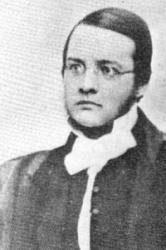
About William Whiting
William Whiting (1825–1878) was an English educator, poet, and hymn writer whose legacy is permanently anchored by one of the most famous maritime anthems in human history. Born in Kensington, London, on November 1, 1825, Whiting received a refined education at Clapham and Winchester. His exceptional musical sensitivity and academic focus led to his appointment as the Master of the Winchester College Choristers' School, a position he held for several decades. Though he published a collection of secular verse titled Rural Thoughts and Other Poems in 1851, it contained no hymns. Whiting dedicated his life primarily to the training of young vocalists and parish ministry in the Church of England until his death in Winchester on May 3, 1878.
"Eternal Father, Strong to Save" — The Navy Hymn
While Whiting composed a small handful of hymns for various high-church Anglican hymnals—including contributions to the Society for Promoting Christian Knowledge Psalms & Hymns and The Hymnary—his international reputation is concentrated almost exclusively on a single masterpiece.
The Masterpiece of Maritime Protection
In 1860, Whiting penned "Eternal Father, strong to save, Whose arm hath bound the restless wave." The lyric was deeply personal, written for a student of his who was about to undertake a treacherous voyage across the Atlantic Ocean. A year later, in 1861, the text was heavily revised and included in the first edition of Hymns Ancient & Modern. It was paired with the hauntingly beautiful tune "MELITA," composed specifically for these words by the legendary church musician John Bacchus Dykes.
   THE MARITIME INTERCESSION
   ┌──────────────────────────────────────────────────────────────────┐
   │ Chorus: O hear us when we cry to Thee                            │
   │         For those in peril on the sea.                           │
   └──────────────────────────────────────────────────────────────────┘
The song captures an intricate Trinitarian structure. Each stanza addresses a different person of the Trinity, pleading for the safety of travelers against the terrifying power of the natural elements:
-
Stanza 1: Appeals to the Father, who established the boundaries of the oceans.
-
Stanza 2: Pleading to the Son, who calmed the stormy waters of Galilee.
-
Stanza 3: Invokes the Holy Spirit, who brooded over the dark waters at creation.
-
Stanza 4: Unites the Trinity in a final prayer of protection.
Global Adoption and Military Heritage
The hymn rapidly outgrew its English parish origins, becoming the official anthem of seafaring forces across the globe. It was adopted by the Royal Navy and the Royal Marines, and it later became deeply embedded in the identity of the United States military, where it is known simply as "The Navy Hymn."
Over the decades, specialized variants of the verses have been officially sanctioned to protect different branches of service, including naval aviators, submariners, and amphibious units. It has been sung at the state funerals of multiple American presidents, including John F. Kennedy, and remains a foundational component of naval academies worldwide.
Summary of Core Hymnological Contributions
| Hymn Title / Common Incipit | Liturgical and Thematic Focus | First Major Publication | Modern Global Presence |
|---|---|---|---|
| Eternal Father, strong to save | Divine providence, protection for travelers, and maritime intercession. | Hymns Ancient & Modern, 1861 | Printed in over 380 major hymnals; translated globally into Welsh, Spanish, German, and Chinese. |
| Jesus Christ, our Savior | Childlike faith, Christ as an example, and devotion for youth. | The Hymnary, 1872 | Maintained across 46 historical collections, written for his choristers. |
| O Lord, the heaven Thy power displays | Evening praise, creation, and divine sovereignty. | S.P.C.K. Psalms & Hymns, 1869 | Utilized regularly within late Victorian Anglican parish books. |
| O Father, who the traveler's way | Safety for overland travelers and trust in divine guidance. | The Hymnary, 1872 | Acted as a terrestrial companion piece to his famous sea hymn. |
A Voice Resounding Across the Waves
William Whiting’s life demonstrates how a single, perfectly crafted creative work can achieve historical immortality. While his other poems and children's pieces faded into obscurity, his magnificent prayer for protection has survived for over a century and a half. Every time a vessel departs from harbor, or a congregation lifts its voice to plead for "those in peril on the sea," the quiet schoolmaster from Winchester continues to provide comfort and hope to generations of sailors navigating the vast and restless oceans of the world.