About William Rees
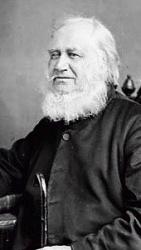
William Rees (Gwilym Hiraethog). Source: Wikipedia
William Rees (1802, 1883), widely recognized by his bardic name Gwilym Hiraethog, was a dominant figure in nineteenth-century Welsh religious, social, and literary life. Born on November 8, 1802, at Chwylfa, near Llansannan in Denbighshire, Rees began his working life as a young shepherd with very little formal education. Entirely self-taught, he mastered English, theology, and the intricate rules of traditional Welsh poetry while tending his flocks. He was ordained as a Congregational minister in 1832, serving churches in Mostyn, Denbigh, and eventually spending several decades leading influential congregations in Liverpool. He became one of the most powerful and eloquent preachers in Wales, using his platform to advocate for political reform, public education, and religious freedom. Beyond the pulpit, Rees founded the first successful Welsh-language newspaper, Yr Amserau (The Times), in 1843, which revolutionized political awareness and journalism across Wales. He passed away in Liverpool on November 28, 1883, celebrated as a national hero of Welsh culture and letters.
Lyrical Focus and Thematic Legacy
The hymns of William Rees are characterized by an intense focus on divine love, redemption, and the cosmic scale of Christian grace. Writing in his native Welsh tongue, he possessed a rare mastery over both the rigid classical bardic meters and the simpler, more fluid structures required for congregational singing.
His text construction masterfully balanced deep, heavy theological concepts with vivid, easily understood natural imagery. He regularly compared the mercy of God to the untamable expanses of the ocean, a thematic choice that resonated profoundly with Welsh maritime and agricultural communities and eventually captured the imagination of believers worldwide.
"Here is Love" — The Anthem of the Welsh Revival
Rees secured an permanent place in global church history primarily through a single masterpiece, "Dyma gariad fel y moroedd" (Here is love, vast as the ocean). Originally penned as a deep reflection on the sacrifice of Christ, this hymn became the defining musical anthem of the historic 1904, 1905 Welsh Revival led by Evan Roberts.
During the height of the awakening, thousands of miners and working-class families sang his stanzas daily, earning it the enduring title of "The Love Song of the Revival." When translated into English, its pairing with the emotive Welsh tune "COLYWN" or "DIM OND JESU" allowed it to cross the globe, establishing it as a foundational hymn for worship movements throughout the twentieth and twenty-first centuries.
Summary of Core Hymnological Contributions
| Hymn Title / Common Incipit | Primary Liturgical and Seasonal Focus | Original Language Context | Historical and Global Impact |
|---|---|---|---|
| Dyma gariad fel y moroedd (Here is love, vast as the ocean) | The crucifixion of Christ; cosmic divine love, justice, and grace. | Originally Welsh; stanzas 1 and 2 form the core English version. | The absolute hallmark of Welsh hymnody; translated globally, including into Malayalam, and sung by millions. |
| Awn at orseddfainc gras drwy ffydd | Boldness in prayer, approaching the throne of grace, and faith. | Purely Welsh liturgical text. | Maintained a steady, trusted presence within standard Welsh nonconformist hymnals. |
| Cydganwn foliant rhwydd | Corporate praise, joy in congregational assembly, and thanksgiving. | Traditional festival hymnody. | Frequently used across Welsh singing festivals, known as Cymanfaoedd Canu. |
| Draw mi welaf ryfeddodau (Far I see the resplendent wonders) | Eschatology, heavenly vision, and the final victory of the cross. | Bilingual printings across Wales and England. | Commemorated for its dramatic, highly visual poetic imagery regarding the afterlife. |