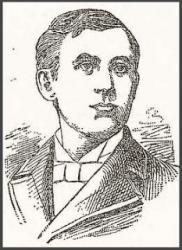
About W. D. Cornell
The Reverend Warren Donald Cornell (1858–1936) was an American teacher, Methodist pastor, traveling evangelist, social reformer, and lecturer whose dynamic career path wound from the schoolhouses of Texas to the pulpits of Wisconsin. Throughout his journey, Cornell was known for his soaring oratory, poetic intellect, and active commitment to civic affairs.
Though his late-career path transitioned away from formal clergy into real estate and political lecturing, he left an indelible mark on global Protestant hymnody by writing the original verses to one of the most beloved gospel songs of comfort in the English language: "Wonderful Peace."
The Lone Star Pulpit and Mid-Western Roots
Warren Donald Cornell was born in Whiteford, Michigan, in 1858. Possessing an analytical mind and a natural gift for communication, he initially trained as an educator. In 1877, at nineteen years of age, he moved to Texas to begin teaching in the Dallas Public School system.
However, his deep personal faith soon redirected his career path. In 1879, he was formally licensed to preach by the Southern Methodist Conference. The young circuit rider was immediately thrust into the intense, rapid growth of the Texas frontier, completing consecutive one-year pastoral appointments in the cities of Denton and Gainesville.
                    ┌──────────────────────────────────────┐
                    │      CORNELL'S VOCATIONAL EVOLUTION  │
                    └──────────────────┬──────────────────┘
                                       │
         ┌─────────────────────────────┼─────────────────────────────┐
         ▼                             ▼                             ▼
  1879: METHODIST CIRCUIT      1881–1904: THE WISCONSIN PULPIT  1905–1936: REFORM & LECTURES
 Licensed to preach in Texas;  Pastored in Oshkosh & Berlin;    Entered real estate; served as
 rode frontier circuits.       founded People's Christian Assn. Union Sec. & political speaker.
In 1880, Cornell married Jennie Estelle Roberts, beginning a robust family that would eventually grow to include five sons (Warren, Louis, William, Robert, and Donald) and one daughter (Florence). Seeking to plant permanent roots closer to home, Cornell relocated his young family to the Oshkosh, Wisconsin area in 1881.
He spent the next two decades establishing himself as one of the region’s most eloquent, passionate preachers, shepherding multiple Methodist pastorates and independent congregations in Berlin and Fond du Lac. In 1894, he took the helm of the People's Christian Association in Fond du Lac, an independent ministry he actively led for ten years before transitioning into non-denominational pastoral work.
Landmark Masterpiece: "Wonderful Peace"
Cornell’s permanent, global legacy was secured during an ordinary, quiet moment of spiritual reflection in 1889 while attending a packed Methodist camp revival meeting in West Bend, Wisconsin.
The Tent Revival Genesis
Feeling profoundly overwhelmed by the spiritual weight of his congregation and seeking a moment of quiet away from the bustling crowds, Cornell stepped into a vacant tabernacle tent. Sitting alone on a wooden bench, he felt a deep, overwhelming wave of divine tranquility wash over him. Reaching into his pocket, he pulled out a scrap piece of paper and hastily penned a five-stanza poem detailing the nature of celestial peace.
When he departed the tent, he accidentally left the paper behind on the bench. A few moments later, a prominent gospel composer and singer named William G. Cooper entered the same tent to rest. Finding the discarded poem, Cooper was so struck by its perfect meter and visceral imagery that he immediately sat down at a small pump organ and composed the sweeping, lilting melody that would carry the text around the world.
Hymn Excerpt: The Celestial Spring
Far away in the depths of my spirit tonight
Rolls a melody sweeter than psalm;
In celestial-like strains it unceasingly falls
O’er my soul like an infinite calm.
Peace, peace, wonderful peace,
Coming down from the Father above!
Sweep over my spirit forever, I pray,
In fathomless billows of love!
The song achieved massive, immediate popularity across the global revival circuits, offering a profoundly comforting, restorative script to a generation navigating the fast-paced, industrial stresses of late-19th-century life.
The Pivot to Civic Reform and Political Lecturing
In 1905, after a quarter-century of intensive pastoral service, Cornell made a sharp, dramatic career shift. Stepping away from formal clergy duties, he entered the real estate market in Wisconsin to support his large family. However, his deep-seated desire to shape public morality did not diminish; instead, it found a brand-new outlet in the American labor and social reform movements.
Cornell became deeply embedded in the complex civic issues of the progressive era:
-
The Paving Cutter's Union: He served as the formal secretary for the regional labor union, actively advocating for the legal protections, fair wages, and physical safety of manual stone cutters.
-
The Anti-Tramp Society: Driven by a desire to address the systemic issue of transient homelessness, he helped organize localized networks to provide structured aid, discipline, and rehabilitation for displaced workers.
-
The Constitutional Defense League: Confronted by the rapid rise of secular political theories in the early 20th century, Cornell became a founding member and primary touring lecturer for this anti-socialist organization, spending his final active years traveling the nation to deliver patriotic and traditional lectures.
By 1925, Cornell and his family had permanently relocated to New York State, where he spent his final twilight years in quiet retirement. He passed away in 1936 at seventy-eight years of age, and his body was returned to his beloved home state to be buried in Fond du Lac, Wisconsin.
While Warren Donald Cornell’s later years were defined by the loud, turbulent worlds of union negotiations and political lecture circuits, his historical legacy remains tethered to that quiet, empty tent in 1889. By translating a fleeting moment of deep spiritual stillness into a timeless lyric, his simple verses continue to offer a profound, "fathomless" language of calm to millions of weary hearts across the globe today.