
101 Common Hymns and Praises
5 days, 23 hours ago
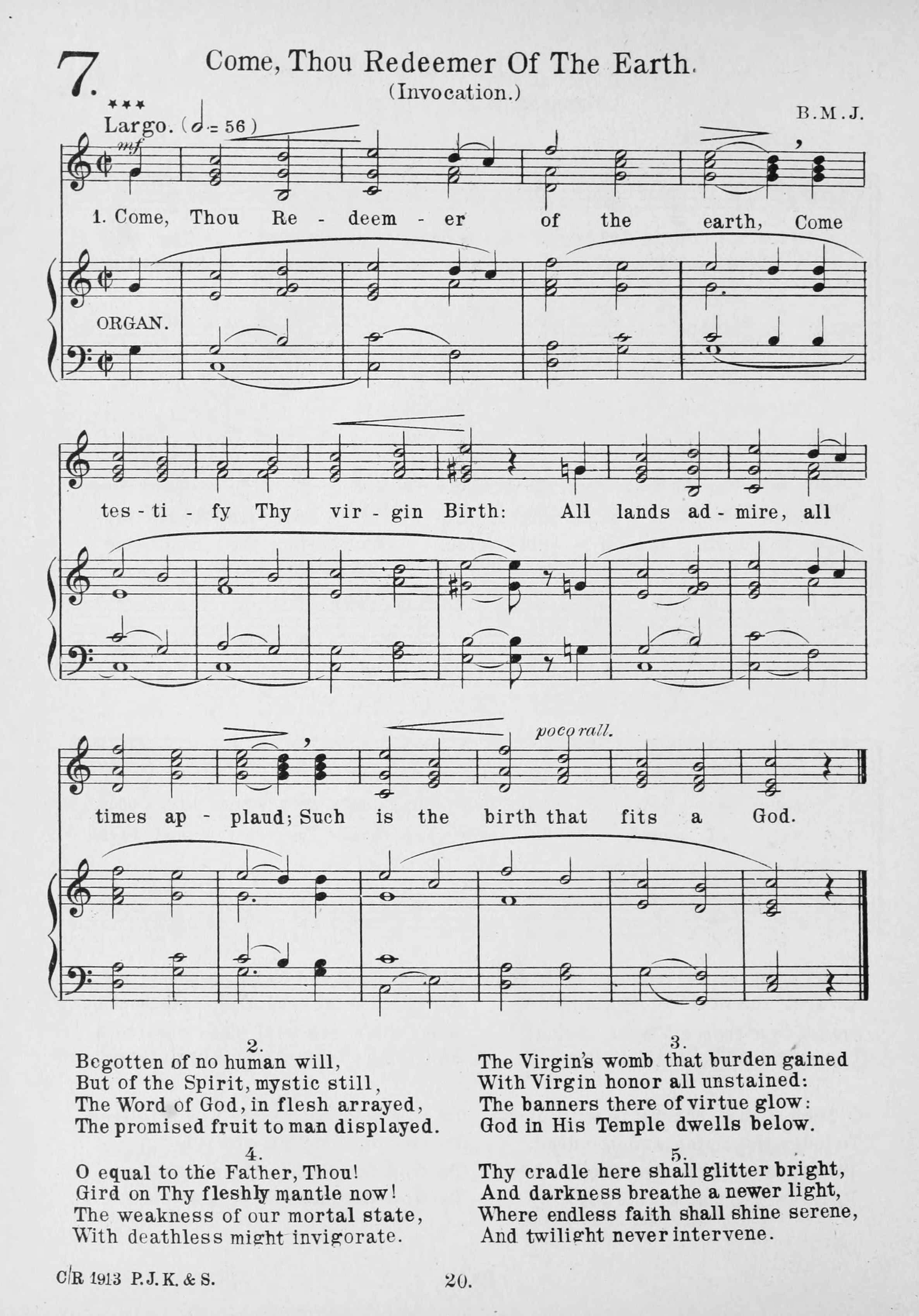
Come, Thou Redeemer of the Earth
By J. M. Neale
Lyrics
1. Come, thou Redeemer of the earth,
and manifest thy virgin-birth:
let every age adoring fall;
such birth befits the God of all.
and manifest thy virgin-birth:
let every age adoring fall;
such birth befits the God of all.
2. Begotten of no human will,
but of the Spirit, thou art still
the Word of God, in flesh arrayed,
the Saviour, now to us displayed.
but of the Spirit, thou art still
the Word of God, in flesh arrayed,
the Saviour, now to us displayed.
3. From God the Father he proceeds,
to God the Father back he speeds,
runs out his course to death and hell,
returns on God's high throne to dwell.
to God the Father back he speeds,
runs out his course to death and hell,
returns on God's high throne to dwell.
4. O equal to thy Father, thou!
Gird on thy fleshly mantle now,
the weakness of our mortal state
with deathless might invigorate.
Gird on thy fleshly mantle now,
the weakness of our mortal state
with deathless might invigorate.
5. Thy cradle here shall glitter bright,
and darkness glow with new-born light,
no more shall night extinguish day,
where love's bright beams their power display.
and darkness glow with new-born light,
no more shall night extinguish day,
where love's bright beams their power display.
6. O Jesu, virgin-born, to thee
eternal praise and glory be,
whom with the Father we adore
and Holy Spirit, evermore. Amen.
eternal praise and glory be,
whom with the Father we adore
and Holy Spirit, evermore. Amen.
Bible Reference
Isaiah 9:6; Luke 2:11-14; Philippians 2:6-11; Matthew 1:21
About This Hymn
“Come, Thou Redeemer of the Earth” is a hymn that combines the early Baroque melody of Michael Praetorius with the 19th-century English translation by John Mason Neale. Praetorius, a German composer and music theorist, originally composed the tune in the early 1600s. Neale, known for his translations of Latin hymns, brought the text into English around 1851, making it accessible for English-speaking congregations.
The hymn is traditionally associated with Advent, emphasizing the anticipation of Christ’s coming. It opens with a plea for the Redeemer to descend and bring salvation, echoing Isaiah 9:6, which foretells the birth of the Messiah. The text situates the believer in a posture of humble expectation, highlighting the world’s need for the Savior.
A central theme is Christ’s incarnation and victory over sin. The hymn calls for spiritual renewal and light to shine upon the faithful, reflecting Philippians 2:6-11, where Christ humbles Himself by taking human form and is exalted by God. The imagery often evokes both joy and reverence, suitable for congregational worship during the season of preparation for Christmas.
Musically, Praetorius’s tune is characterized by flowing, graceful lines typical of early Baroque hymnody. The melody supports the contemplative and expectant tone of the text, allowing singers to meditate on Christ’s redemptive work while participating in communal worship.
“Come, Thou Redeemer of the Earth” endures as a cherished hymn for Advent and other liturgical celebrations. Its combination of rich musical heritage and carefully rendered English text provides both theological depth and devotional warmth, leading worshipers to reflect on the mystery and joy of Christ’s coming into the world.

📬 Subscribe to Our Devotional Updates
Receive weekly hymns, devotionals, and website features directly in your inbox.
✅ Thank you! You'll start receiving our updates soon.
⭐ Recommend This Hymn
Share this beautiful hymn with others
This hymn is found in these hymnals
Open the hymnal that contains this hymn:
Recently Added Hymns
-
 New Every Morning Is the LoveJohn Keble 1822
 -
 This day, at Thy creating wordWilliam Walsham How 1871
 -
 O God, Creation's Secret ForceSt. Ambrose 400
 -
 Jesus Thank You (Your Blood Has Washed away My Si…Sovereign Grace Music 2003
 -
 How Long, O Lord, How Long? (Psalm 13)Brittany Born, David Zimmer, … 2022
Latest Updated Hymnals
-
Open
 Book of Common Praise (BCP1998)Updated 4 days, 6 hours ago · 1998
 -
Open
 Our Great Redeemer's PraiseUpdated 4 days, 6 hours ago · 2022
 -
Open
 A New Hymnal for Colleges and SchoolsUpdated 2 weeks ago · 1992
 -
Open
 Sing! HymnalUpdated 3 weeks, 1 day ago · 2025
 -
Open
 New Jewish HymnalUpdated 3 weeks, 1 day ago · 1917
Hymn Information
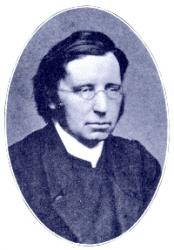
To view the author's biography, click their name above.
MIDI File
Ready to load
Download MIDI
Popular Hymns
Recent Blog Posts


Popular Blog Posts
-
 The Full Story of the Birth of Jesus Christ:…4 months, 3 weeks ago
 -
 The 30 Most Famous Christmas Hymns and Carols8 months ago
 -
 Easter vs Passover: How a Biblical Feast Bec…1 month ago
 -
 50 Most Sung Hymns Today: the Most Beloved S…5 months, 1 week ago
 -
 Top 100 Christmas Hymns for 20265 months, 2 weeks ago
Visit Us on Social Media
Latest from X (Twitter)
Tweets by HymnalLibraryLatest from Facebook
Latest on YouTube
Loading latest video...
Daily Bible Verse
Disclaimer
The hymns, sheet music, MIDI files, and related content on this website are provided for educational and research purposes only.
- Public Domain: Many of the hymns featured here are in the public domain and may be freely used.
- Copyrighted Works: Some hymns may still be under copyright protection. Where applicable, permission has either been requested from the copyright owner, or the content is shared under the principles of fair use for educational purposes.
⚠️ Important Notice: If you wish to reproduce, distribute, or use any copyrighted hymn beyond personal study or educational use, you must obtain permission directly from the copyright holder. This website does not grant any rights for commercial use yet.
If there is any other question please address it to us in our Contact Page, for further assistance. Thank you for using the site. May God Bless You.